Gertrude
William TellGertrude is Werner Stauffacher’s wife and a daughter of Iberg, but her importance rests not only on her place in his household: she recognizes the political meaning of his distress and urges him to act. In the scene beneath the lime tree, her intervention helps move the play from private sorrow toward organized resistance to Gessler’s rule.
Identity and Introduction
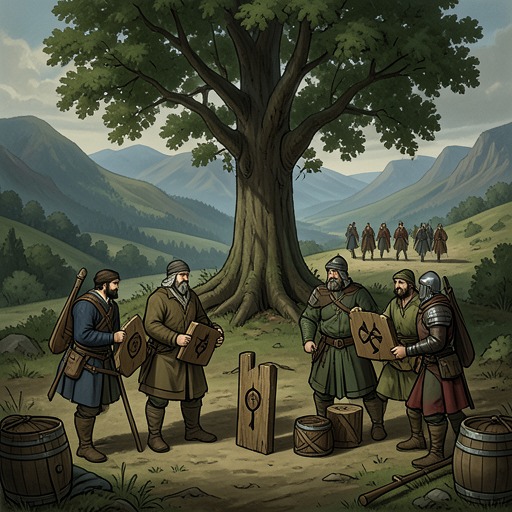
Werner Stauffacher sits sorrowfully on a bench beneath a lime tree when Gertrude enters and finds him there. The stage picture makes her the first witness to his distress. Rather than leave his silence uninterpreted, she addresses him as her dear lord and husband and asks whether he will accept honest counsel from her. Her appeal establishes intimacy, but also authority: she claims the right to advise him.
Gertrude identifies herself as Iberg’s daughter, invoking a family identity as she speaks. The play gives no further account of her background, but this brief self-identification accompanies a confident entrance into political discussion. She is not presented simply as a listener to her husband’s concerns; she speaks into them.
Counsel Against Gessler’s Rule
Gertrude names the condition that weighs on the people of the Canton of Schwyz: worthy men, she says, are groaning under Gessler’s grasping tyranny. Her description gives Stauffacher’s sorrow a public cause. The grievance is not confined to what has happened to one household; it is a shared oppression affecting the community.
She announces that she has advice, but the supplied passage does not preserve its full substance. The next clear turn in the exchange is Stauffacher’s decision to go directly to Uri, where his worthy comrade Walter Furst lives. The scene therefore establishes Gertrude as an instigator of deliberation and a catalyst for her husband’s movement toward allies, without specifying every step of the counsel she gives.
Marriage and Political Partnership
The play binds Gertrude’s marital tenderness to the stakes of resistance. Stauffacher answers her presence by invoking the value of the heart she gives him and the cause of hearth and home; he then takes leave to go to Uri. The domestic bond is thus not an escape from political conflict but one of the things that gives that conflict urgency. His departure is framed as action on behalf of a home and a shared life, not as an abstract contest for power.
Gertrude’s position in the exchange is also significant because she asks to be heard as a counselor. The scene gives her a direct voice in the formation of resistance, even though the surviving evidence does not show her joining the later councils or specifying the eventual plan. Her influence is most clearly visible at the threshold: she helps turn a husband’s private grief toward conversation and action.
From Private Grievance to Public Resistance
Later, Werner Stauffacher articulates the political principles that frame the resistance: the communities freely sought imperial protection, yet even the freest people have a feudal lord; their obligation is to aid the empire with their swords, not to accept unlimited local tyranny. Walter Furst states that they will do what necessity requires, but no more, and that the tyrants and their agents must be driven out. These later arguments are not attributed to Gertrude, but they clarify the larger movement into which her early intervention feeds: a distinction between legitimate obligations and coercive rule.
Gertrude’s dramatic role is therefore concentrated but consequential. She names oppression, offers counsel, and helps initiate Stauffacher’s journey to Walter Furst. The movement from the lime-tree bench to a public defense of ancient rights begins with an intimate exchange in which a wife insists that her husband listen.